

Chemical UV filters generally keep sunscreen truly transparent, while physical filters often leave a visible white cast. For readers seeking an invisible finish under makeup or on deeper skin tones, chemical formulations are the superior choice. Physical filters offer a gentler profile for sensitive skin but require specific micronization to reduce opacity. Sonrei addresses this trade-off by engineering clear gel technologies that maximize transparency without sacrificing broad-spectrum protection. according to Modernizing U S
Chemical UV Filters: The Transparency Standard
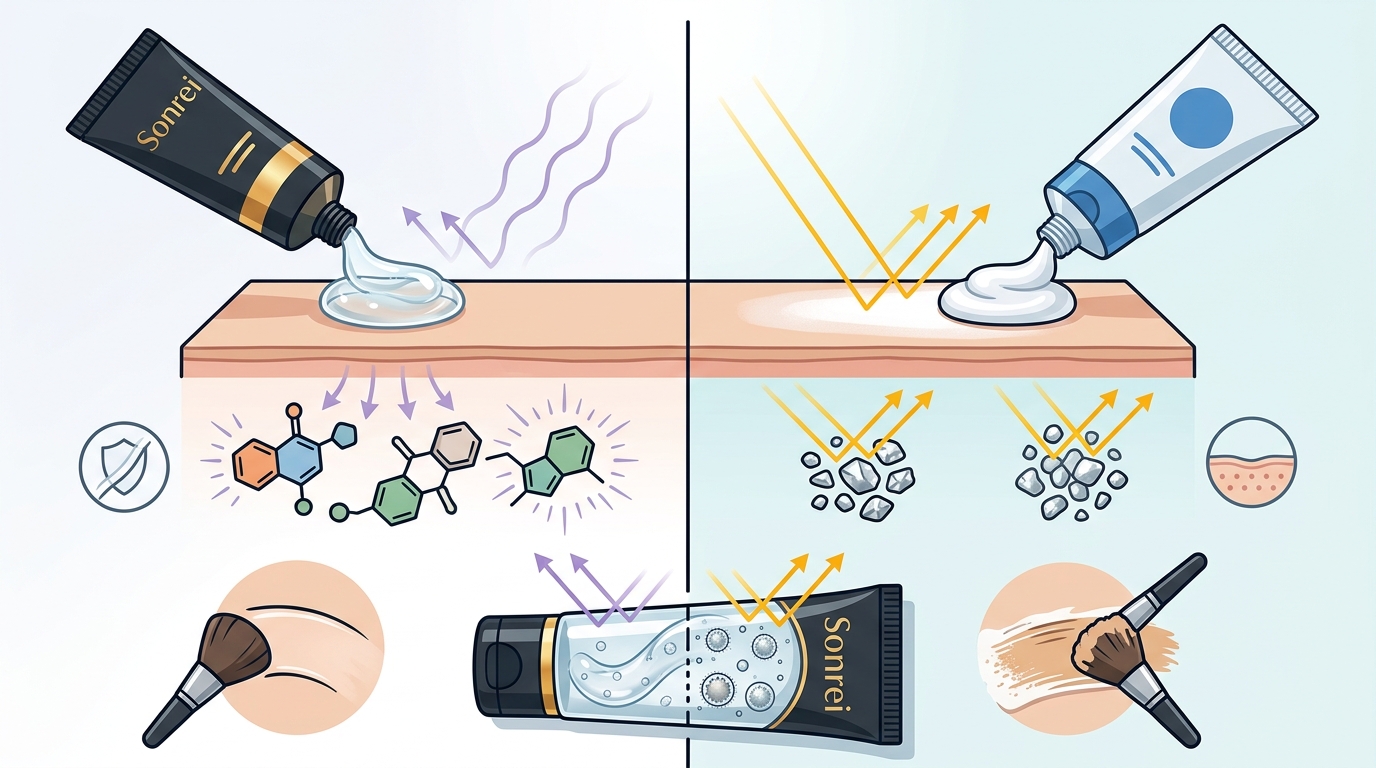
Chemical UV filters are organic compounds that absorb ultraviolet radiation and convert it into heat. These molecules, such as avobenzone and octocrylene, are typically transparent in their pure state. When formulated into a liquid or gel base, they do not scatter visible light. This property allows chemical sunscreens to dry down to a completely invisible finish. For users who prioritize cosmetic elegance, this is the primary advantage. The absence of a white cast makes chemical filters ideal for daily wear under foundation or on darker complexions where mineral residue is most noticeable.
Formulation and Finish
Modern chemical sunscreens often use alcohol-based or water-based gel systems to enhance spreadability. These bases evaporate quickly, leaving behind a smooth, matte, or satin finish. The transparency of the active ingredients ensures that the final product looks like a skincare primer rather than a cosmetic layer. This is particularly important for users with oily or combination skin who want protection without added shine or heaviness. Sonrei’s Sea Clearly line utilizes this approach to deliver a clear, weightless barrier that disappears into the skin.
Limitations and Considerations
While superior in transparency, some chemical filters can be irritating to highly sensitive skin. Certain individuals may experience stinging or redness when applying organic filters. Additionally, some older chemical filters are photounstable, meaning they break down in sunlight. This necessitates reapplication to maintain efficacy. However, newer filters and stabilizing agents have largely mitigated these issues. The key takeaway is that chemical filters offer the best visual result but require careful ingredient selection for reactive skin types.
Physical UV Filters: The Gentle Alternative
Physical UV filters, also known as mineral filters, are inorganic compounds that reflect and scatter ultraviolet radiation. The two primary ingredients are zinc oxide and titanium dioxide. These particles sit on the surface of the skin rather than being absorbed. Because they are opaque in their standard form, they create a visible white layer. This is the fundamental limitation for transparency. However, advancements in particle size and dispersion technology have significantly improved the cosmetic appeal of mineral sunscreens.
Micronization and Clarity
Manufacturers reduce the opacity of physical filters through micronization, which shrinks the particle size. Smaller particles scatter less visible light, resulting in a more transparent finish. Some modern mineral sunscreens use nano-sized particles to achieve near-invisibility. Yet, even with micronization, a slight white cast often remains, especially on deeper skin tones. This residue can interfere with makeup application and may appear chalky. For users who prioritize a completely invisible finish, physical filters may still fall short compared to their chemical counterparts.
Skin Sensitivity and Safety
The primary advantage of physical filters is their gentleness. Zinc oxide and titanium dioxide are inert and less likely to cause irritation or allergic reactions. This makes them the preferred choice for sensitive, reactive, or compromised skin barriers. They are also the only filters currently classified as Generally Recognized as Safe and Effective (GRASE) by the FDA. For individuals with eczema, rosacea, or post-procedure skin, the trade-off of a slight white cast for enhanced safety is often worth it. Sonrei’s Clearly Zinq line offers a mineral option that balances this gentleness with a more refined, less chalky texture.
Filter Type Comparison Matrix
| Criteria | Chemical Filters | Physical Filters |
|---|---|---|
| Transparency | High; dries completely clear | Low to Medium; often leaves white cast |
| Skin Sensitivity | Potential for irritation in reactive skin | High; inert and gentle on sensitive skin |
| Makeup Compatibility | Excellent; acts as a primer | Fair; may cause pilling or residue |
| Regulatory Status | Approved but under review for safety | GRASE status; highest safety profile |
| Texture | Lightweight, fluid, or gel | Thicker, creamier, or paste-like |
Choosing the Right Filter for Your Skin
Selecting between chemical and physical filters depends on your specific skin needs and cosmetic preferences. There is no single "best" filter for everyone. The right choice balances protection, comfort, and visual appeal. Consider the following guidance to make an informed decision.
Choose Chemical Filters If
You prioritize an invisible finish under makeup. You have normal to oily skin that tolerates organic ingredients well. You want a lightweight texture that does not feel heavy or occlusive. You are concerned about the white cast associated with mineral sunscreens on deeper skin tones. Sonrei’s clear gel formulations are designed for this user profile, offering high transparency and broad-spectrum coverage.
Choose Physical Filters If
You have highly sensitive, reactive, or compromised skin. You are prone to irritation from chemical ingredients. You prioritize the highest safety profile and GRASE status. You do not mind a slight white cast or can blend it effectively. You are using sunscreen on post-procedure or healing skin. Sonrei’s mineral gels provide a gentler option for these users, minimizing irritation while maintaining protection.
Frequently Asked Questions
Can I mix chemical and physical filters in one product?
Yes, many modern sunscreens use a hybrid approach. These formulations combine the transparency of chemical filters with the gentleness of physical filters. This allows for a more balanced product that offers broad-spectrum protection with a refined finish. Hybrid sunscreens can be a good middle ground for users who want some of the benefits of both types.
Do physical filters really cause white cast on all skin tones?
Not all, but the effect is more pronounced on deeper skin tones. On lighter skin, a slight white cast may be less noticeable or even blend in. However, on medium to deep skin tones, the residue is often very visible. Micronized particles help reduce this effect, but it rarely disappears completely. Chemical filters remain the superior choice for invisibility on all skin tones.
Are chemical filters safe for daily use?
Yes, when used as directed. The FDA has approved several chemical filters for use in sunscreens. While some ingredients are under ongoing review, current evidence supports their safety for the general population. Individuals with specific sensitivities should patch test new products. Consulting a dermatologist can help identify which filters are best for your skin type.
Which filter type is better for sensitive skin?
Physical filters are generally better for sensitive skin. Zinc oxide and titanium dioxide are inert and less likely to cause irritation. They are also the only filters with GRASE status. If you have reactive skin, eczema, or rosacea, a mineral sunscreen is often the recommended starting point. Look for formulations that are fragrance-free and free of other potential irritants.
How does particle size affect mineral sunscreen transparency?
Smaller particles scatter less visible light, resulting in a more transparent finish. Micronization is the process of reducing particle size to improve cosmetic appeal. However, even with micronization, some opacity remains. The goal is to find a balance between protection and transparency. Non-nano particles are often preferred for safety, but they may be less transparent than nano-sized particles.
Final Verdict on Transparency
For true transparency, chemical UV filters are the clear winner. They dry down to an invisible finish, making them ideal for daily wear and makeup application. Physical filters offer a gentler profile for sensitive skin but often leave a visible residue. The best choice depends on your individual skin needs and cosmetic preferences. Sonrei offers both clear chemical gels and refined mineral options, allowing you to select the filter type that best suits your routine. Explore the facial sunscreen collection to find the perfect balance of protection and transparency for your skin.